Platform Journey
Summary
The platform journey is the reader path through LKCI's engineering story. It explains the platform as a composable operational system: durable primitives, workflow state, human repair, source-backed data, and automation that remains inspectable.
The thread starts with general architecture, links to reusable primitives, and then lets readers descend into workflow and methodology posts when they want more depth.
Reader Question
How should a technical reader move through the platform story without needing to understand every implementation package first?
Surface Or Workflow
The entry surface is the public static export. A reader sees pages that have been explicitly reviewed for external publication. The public build excludes the full internal inventory and keeps graph/search output scoped to reviewed pages.
The editorial workflow starts internally. Engineers draft source-backed pages, then choose which concepts are useful to a public technical audience. Public pages should explain architecture and rationale first; implementation-heavy pages can remain internal when the code path is the main value.
Lifecycle
The lifecycle starts with internal knowledge: platform map, layers, monorepo posture, failures-as-data, thin jobs, service boundaries, and reviewable operations. A publication candidate is then checked for private identifiers, private URLs, raw metrics, sensitive source details, and unreviewed visuals.
Once reviewed, the page can enter the public export. The export keeps content, visuals, search, and graph artifacts aligned with the public slice rather than shipping the internal repo map. Future hosted public publishing should remain separate from the internal preview target.
Child Threads
- Platform Architecture: architecture and layers.
- Composable Operations: jobs, services, and review surfaces as reusable patterns.
- Human Repair: failures-as-data and human correction.
- Source-Backed Documentation: how repo evidence supports writing while exports stay filtered.
- Export Review Process: metadata, visual review, and redaction gates.
Implementation Boundaries
docs/public/platform-journey-strategy.md is the writing strategy source. The engineering content contract and static-site public mode enforce metadata gates. Public pages may link to reviewed engineering pages, but the export must not include private inventory maps or unreviewed visuals.
Tradeoffs
Public content is less implementation-specific than internal content. That is the point. It should preserve the architectural lessons while avoiding pages whose value depends mostly on direct codebase access.
Visual
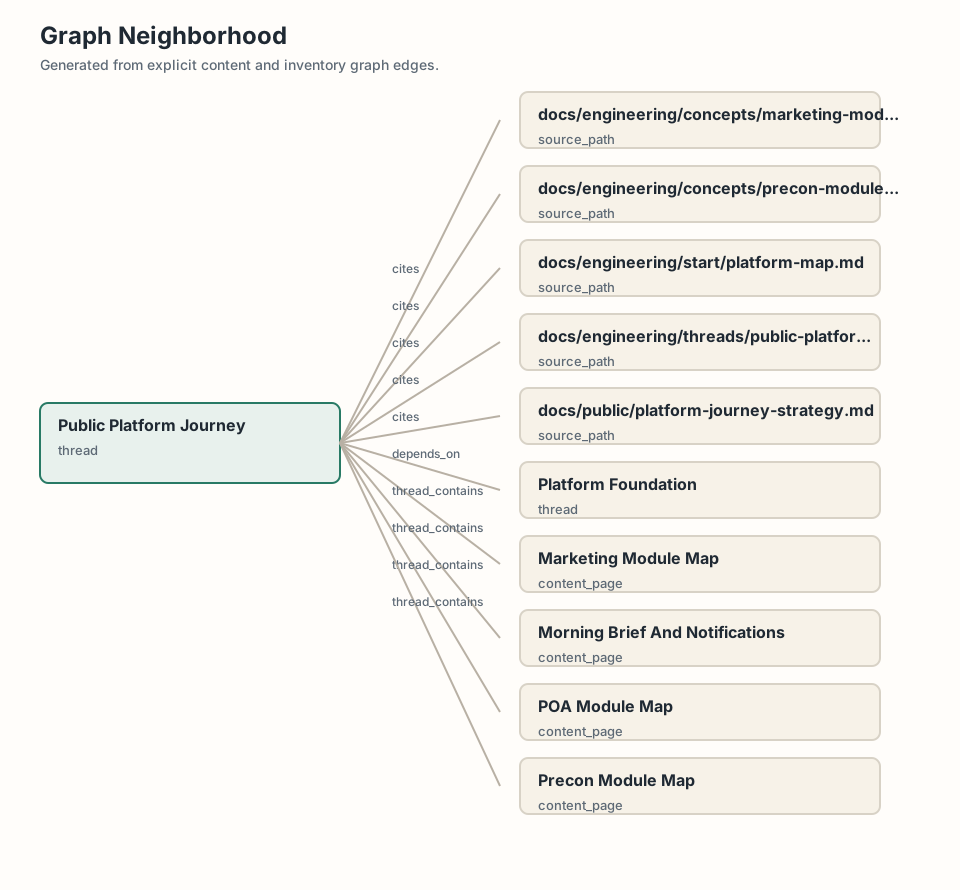
The current visual is a public-reviewed graph neighborhood. The intended thread-level visual is a public export filter diagram: internal pages, reviewed public slice, redacted graph/search artifacts, visual review, and hosted publishing path.
How To Read This Site
The public platform journey should be read as a guided entrance into the way LKCI thinks about operating work, not as a product brochure and not as a raw source map. The first useful question is not "what technology stack is this?" It is "what kind of operating company needs this kind of platform?" LKCI has recurring work that crosses data capture, job execution, human judgment, external providers, and customer-facing communication. The platform exists because those pieces need to compose without every new workflow becoming a private script, a spreadsheet, or a one-off dashboard.
The best starting point is therefore architectural. The platform foundation explains the durable primitives: pipelines, jobs, services, integrations, review surfaces, data boundaries, and UI/API adapters. A reader who understands those primitives can then move into domain systems like marketing, geo, POA, precon, payroll, notifications, and operations without treating each one as a separate application. The systems are intentionally different in business purpose, but they reuse the same operating posture.
The second reading move is workflow-first. A technical reader should not need to start by inspecting package internals. They should be able to begin at a recognizable surface: a marketing campaign, a geo map, a POA repair queue, a precon opportunity workspace, a payroll review grid, or a production diagnostic. From there, links descend into state machines, methodology posts, provider boundaries, route families, service packages, tests, and guardrails. That is how the site avoids two common documentation failures: vague narrative at the top and unorganized implementation detail at the bottom.
The third move is evidence. Public pages are allowed to cite source paths when those paths support an architectural claim. The source path is not the article; it is the receipt. A reader without the codebase should still understand the argument. A reader with the codebase should be able to verify that the argument is grounded in real modules, tests, or docs. That double use is why the site is more like a knowledge graph than a traditional blog archive.
What This Says About The Company
The public value of this site is that it shows a mechanical contractor thinking about operations as a system. The company still performs practical field work, but the platform story makes clear that scheduling, purchasing, preconstruction, marketing, payroll, finance, communications, and service-area analysis are not isolated administrative chores. They are connected workflows with state, evidence, decisions, and consequences.
That matters for technical readers because the architecture is shaped by real operating pressure. A demo platform can be optimized for clean examples. This platform is optimized for messy provider boundaries, incomplete documents, ambiguous matches, stale data, retries, human repair, and auditability. The public journey should make that visible without exposing every internal detail.
The site should also leave room for future public content that is less software-specific. Geo and market intelligence, for example, can show how the same data discipline helps LKCI understand its service area, property patterns, commercial activity, and operational reach. That broader narrative belongs beside the engineering story, not inside every engineering post. This page keeps the two connected: the engineering site explains the platform; future public intelligence content can show what disciplined platform work makes possible.
Publication Standard
The public journey also sets the editorial bar for the rest of the site. A post should not merely prove that a source path exists. It should help a technical reader build a mental model. That means the article should start from a real workflow or decision, explain why the boundary matters, show how state moves, identify failure modes, and link to narrower posts only when the reader needs more depth.
This matters because LKCI's platform can otherwise look like a dense internal catalog. The public version should feel more like a series of field notes from an operating company with a serious engineering practice. It can be technical, but it should not require the reader to open the repo to understand the argument. The source-backed graph is the supporting structure; the prose is the experience.
The same standard should apply to future public content outside the engineering site. A service-area analysis or built-environment intelligence article should not simply display a map. It should explain the question, the method, the evidence, the limits, and the operational interpretation. That is the brand connection: the company thinks about real-world work with systems discipline.
Reading Path For A New Engineer
A new engineer should be able to use this thread as the first hour of orientation. The right path is not to start with every module. It is to learn the platform posture, then follow one complete workflow from UI surface to state, service, job, integration, and diagnostic evidence. Marketing is a good first example because it touches authoring, audiences, geo, templates, suppression, scheduling, delivery, attribution, and provider boundaries. POA or payroll is a good second example because the shape is smaller and more stateful.
The expected reading pattern is recursive. A broad thread should explain what the system is trying to accomplish and why its boundaries exist. A deeper thread should explain a workflow or methodology. Reference pages should explain provider boundaries, schemas, services, and implementation anchors. The reader can stop at any layer and still retain a coherent picture.
That is the main difference between this site and a conventional API reference. The goal is not only to answer "where is the code?" The goal is to answer "what is this part of the platform responsible for, what does it refuse to own, and how would I extend it without breaking the operating model?"
For public readers, that last question is the most important one. The site should make the platform feel understandable without flattening it into a marketing story. It can show that LKCI builds software around operational judgment, not as a detached technology showcase.
Source Evidence
docs/public/platform-journey-strategy.mddocs/engineering/start/platform-map.mddocs/engineering/architecture/platform-layers.mddocs/engineering/architecture/monorepo-as-operational-platform.mddocs/engineering/concepts/failures-are-data.md
Related Threads
Internal Context
Internal readers can continue into Platform Foundation, Data Boundaries, and Automation With Human Repair. In public exports, references outside the published slice render as plain text.